Crane Rental vs Buying: Which is Better for Your Business?
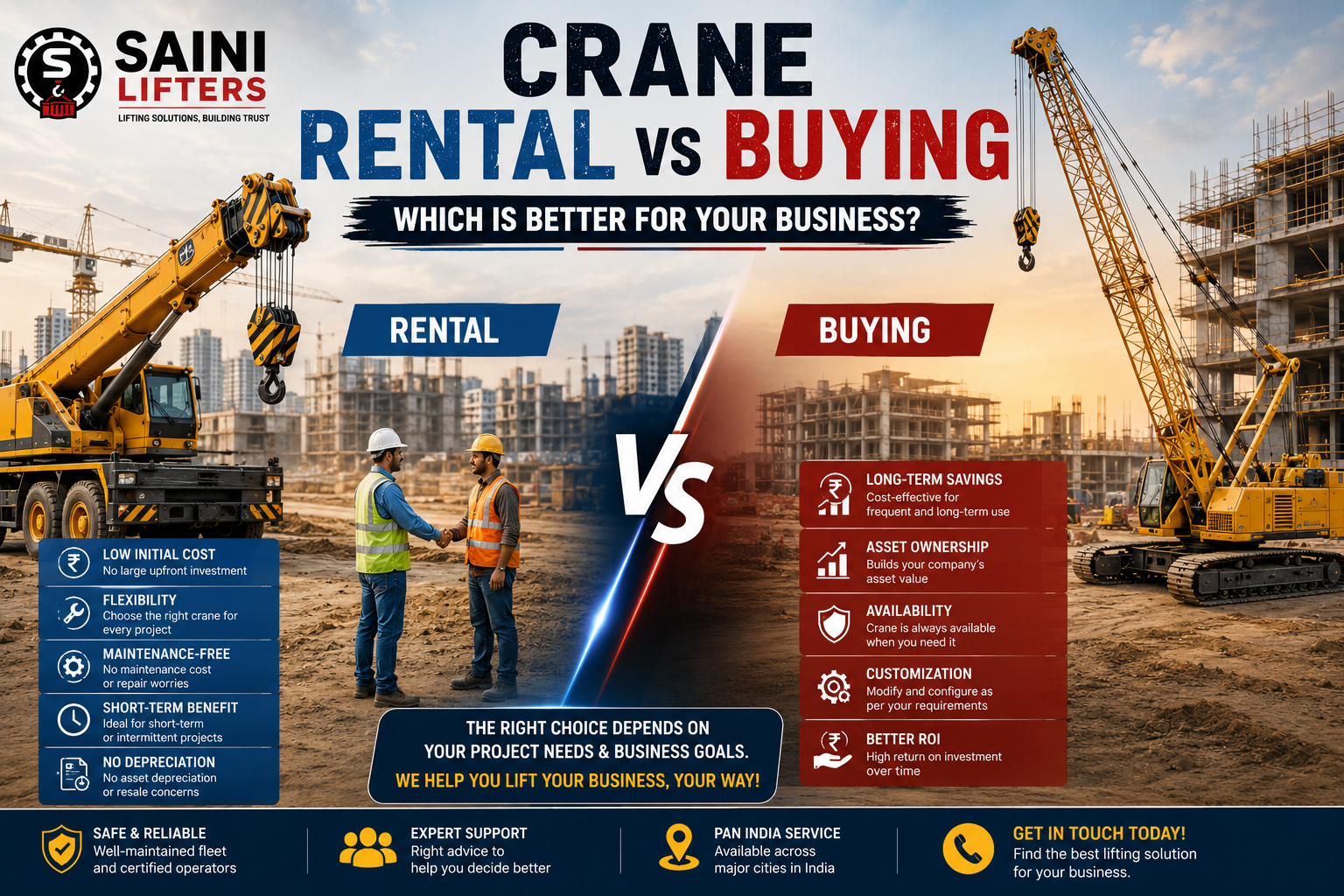
For construction companies, industrial businesses and project managers in India, the question of whether to rent or buy a crane is a significant financial decision. The answer is rarely obvious — it depends on how often you need a crane, what capacity you need, how much capital you have available, and what your core business is. This guide gives you a practical, data-driven framework to make the right call for your specific situation in 2026.
In Navi Mumbai, Panvel and the broader Raigad industrial belt, we see two types of businesses constantly grappling with this question: MIDC factory managers who need hydra cranes or pick-and-carry cranes semi-regularly, and construction contractors who occasionally need large all terrain or crawler cranes for specific project phases. The right answer for each is different — and we'll address both below.
Advantages of Renting
- ✓No large capital outlay (₹8–12 crore for an all-terrain crane)
- ✓Maintenance, insurance and storage costs handled by the rental company
- ✓Access to the latest, well-maintained equipment
- ✓Only pay for what you use - flexible project-by-project basis
- ✓Certified operators included - no HR headaches
- ✓Scale up or down based on project requirements
- ✓No depreciation risk as crane technology evolves
Advantages of Buying
- ✓Available 24/7 on your own schedule with no booking dependency
- ✓Can generate rental income when not in use
- ✓Long-term cost savings if crane is used daily for years
- ✓Full control over maintenance schedule and usage
The Financial Reality in India: What Does Owning a Crane Actually Cost?
A new XCMG QAY300 all-terrain crane costs ₹8–12 crore to purchase outright. Add annual maintenance (₹20–40 lakhs), insurance (₹5–10 lakhs/year), storage yard rent, operator salaries (₹4–8 lakhs/year per operator) and regulatory compliance (DGMS certification, load testing, periodic inspections) — and the total cost of ownership is enormous. For most businesses in Navi Mumbai that don't need heavy cranes every single working day of the year, renting at ₹50,000–₹1,50,000/day is far more economical.
The breakeven calculation is simple: if a crane would be productively used more than 250 days per year for 5+ years, and you have the capital and the crane-operating expertise in-house, buying can make sense. If the crane sits idle for more than 100 days a year — which is almost universal for contractors who are project-dependent — renting wins decisively. For specialised equipment like 300T all terrain telescopic cranes or crawler cranes, the breakeven point is rarely reached by any single business.
When Renting Makes More Sense
- ✓Your business needs cranes only occasionally (not daily year-round)
- ✓You need different crane sizes/types for different projects
- ✓Capital is better deployed in core business activities
- ✓You want to avoid the risk of crane depreciation and obsolescence
- ✓Your projects are geographically spread across Navi Mumbai and beyond
- ✓You need specialised equipment (300T all-terrain) not needed permanently
When Does Buying a Crane Make Sense in India?
Buying is the right call for a specific profile of business: large crane rental companies (who rent to others), major infrastructure contractors with guaranteed 300+ days/year utilisation, and businesses with a specific recurring need (e.g., a port operator who needs a reach stacker operating every single working day). In these cases, the capital cost is amortised and the daily operating cost of an owned crane can fall below market rental rates after year 3–4.
The hidden risks of buying that are frequently underestimated: crane technology is evolving — an XCMG crane bought in 2020 may already be superseded by more capable models in 2026 with better telematics, lower fuel consumption and higher rated capacities. Depreciation on heavy cranes can run 8–15% per year. And when a crane breaks down with an owned asset, the downtime cost — lost project revenue, contract penalties — falls entirely on you. With a rental company, breakdown coverage and backup deployment are the operator's problem, not yours.
Hybrid Strategy: Own Small, Rent Large
The most financially intelligent approach we see among large MIDC contractors and construction companies in Navi Mumbai is a hybrid model: own the equipment you use daily (small forklifts, hydra cranes, manlift platforms that run 5+ days a week), and rent the heavy equipment you need occasionally. This means:
- ✓ Own small forklifts, hydra cranes or manlift platforms used daily — these have high utilisation and fast breakeven
- ✓ Rent all terrain telescopic cranes (160T–300T) for specific project phases — avoid ₹10 crore capital commitment for intermittent use
- ✓ Rent crawler cranes for long-duration bridge or infrastructure phases — avoid complex assembly/disassembly logistics becoming your problem
- ✓ Rent reach stackers for port operations during peak import/export cycles instead of committing to year-round ownership
- ✓ This hybrid approach preserves capital for business growth while giving access to the full range of equipment when needed
Rent a Crane in Navi Mumbai from Saini Lifters
Saini Lifters has served Navi Mumbai's construction and industrial sector since 2001 with a modern, well-maintained fleet. Call us for a free consultation on the right equipment for your project.